
Article: What a Blind Wine Tasting Really Shows
What a Blind Wine Tasting Really Shows
By The Argaux team
A blind wine tasting shows you what a wine tastes like once the label, producer, region and price are out of the picture. Published research shows what that changes. In one study, the color of a wine changed what 54 wine students smelled. In 6,175 blind ratings, tasters without wine training liked pricier wines slightly less, on average. Even trained competition judges struggled to repeat their own scores. Here is what each study found, and what to do with it at your own table.
What a blind wine tasting is
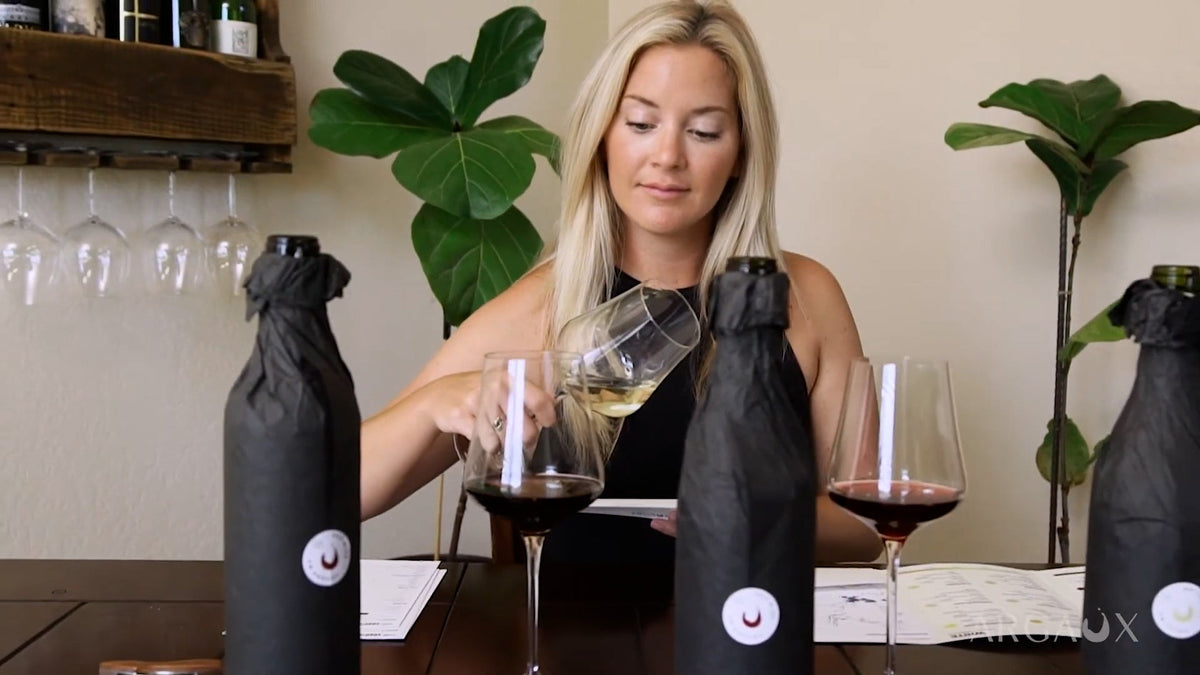
A blind wine tasting is a tasting where you don't know which wine is in your glass. The bottles are covered, so you judge by sight, smell and taste, then call the grape, region, vintage and price. After that, you reveal the labels and see how close you got.
Wine professionals use it to train their palates. Everyone else does it because it's a good time, and because opinions get honest when nobody can hide behind a famous name.
What it hides, and what it does not
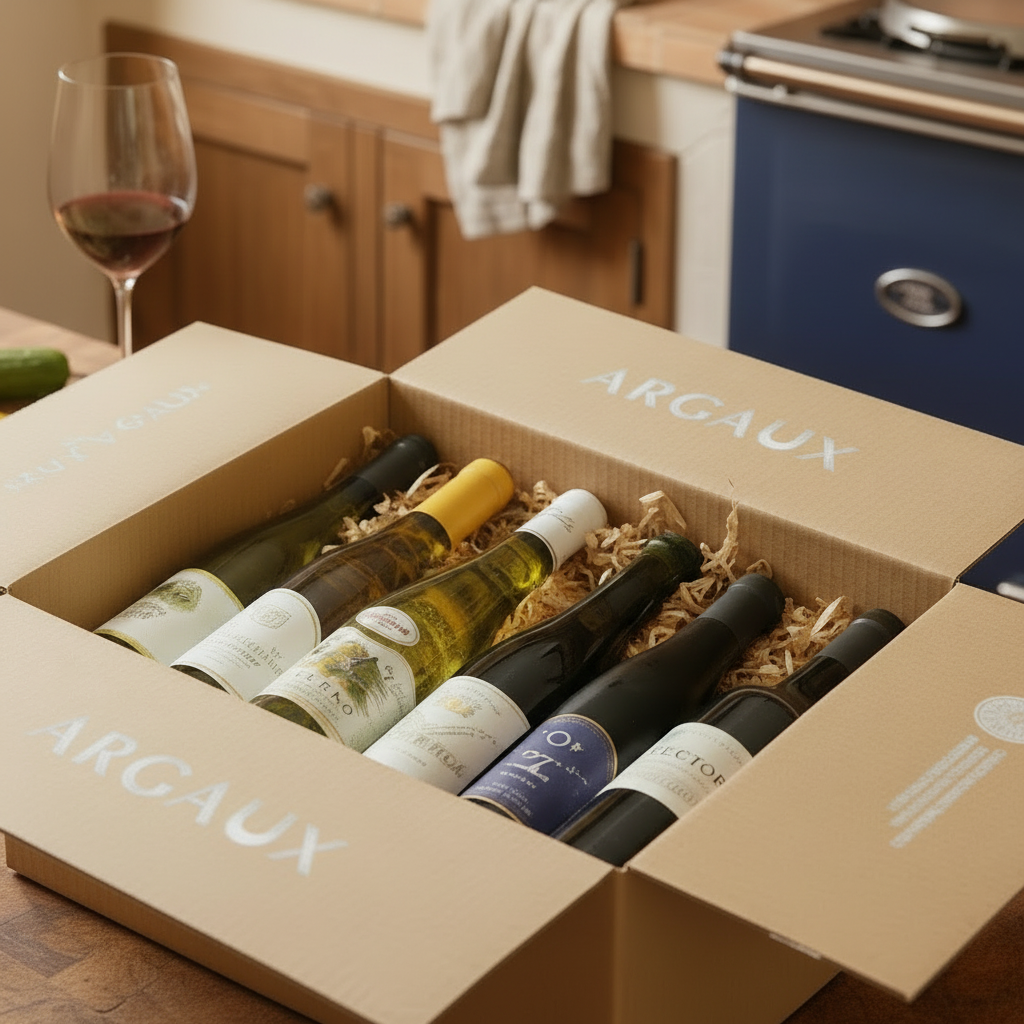
An Argaux Blind Wine Tasting Kit hides four things: the label, the producer, the region and the price. Each wine arrives wrapped in tissue paper with a numbered seal. The seal shows the tasting order and the style of wine. So the kit does not hide style, and it does not hide color, which shows in the glass the moment you pour.
That leaves you two honest clues before you taste a drop. Everything that usually comes with a famous name or a big price tag stays covered until you make your call.
The largest study below was run much the same way. Its tasters could see each wine's color and knew nothing else about it.
What the research found
Three published studies are worth knowing. Every number below comes from the paper itself, and each paper is linked at the end.
Your eyes change what your nose says (Morrot, 2001)
For a study published in 2001, Gil Morrot, Frédéric Brochet and Denis Dubourdieu asked 54 wine-science students at the University of Bordeaux to describe the smell of a white wine and a red wine. A week later, the same students got the white again, next to a second version of it dyed red with an odorless grape pigment. They described the dyed white with the words they had used for the red.
That study was not a blind tasting. The students could see the color, and it overrode what their noses were telling them. The authors call it a perceptual illusion.
At your table: treat color as a clue. Notice it, write it down, then check whether your nose agrees.
Price and pleasure (Goldstein and colleagues, 2008)
Robin Goldstein and five co-authors analyzed 17 blind tastings he organized in the US between April 2007 and February 2008. In all, 506 people tasted 523 different wines priced from $1.65 to $150 a bottle. Neither the tasters nor the people pouring knew anything about a wine except its color. Each taster rated every wine Bad, Okay, Good or Great before the group talked, which gave the researchers 6,175 ratings.
On average, tasters without wine training, who were most of the group, rated pricier wines slightly lower. About 12 percent of tasters had some training, such as a sommelier course. Their ratings did not fall as price rose, and the data hint that they liked pricier wines a bit more. The authors translate this to a 100-point scale: for a wine ten times the price, about four points lower from tasters without training and about seven points higher from tasters with it. They are careful about that second number. It is statistically shaky, and they call it an open question whether the effect is really positive. The authors also point out that their volunteers, aged 21 to 88, probably included more food and wine professionals than the general public does.
At your table: decide what you like first, and look at the price after. A blind tasting is the easiest way to do that, because the price can't lean on your opinion.
Why blind tasting is hard, even for judges
Color can pull your nose off course. Judges have a different problem, which is repeating themselves.
In a study published in 2008, Robert Hodgson of Humboldt State University tested judges at the California State Fair wine competition in Sacramento. The judges there included winemakers, wine buyers, wine critics and enology professors. Between 65 and 70 judges were tested each year from 2005 to 2008. Each panel of four judges tasted a flight of 30 wines. Hidden in the flight, the same wine showed up three times, poured from the same bottle. Hodgson built the test to give judges the best chance of repeating themselves, and he used each judge's first score, given before the panel talked.
Only about 10 percent of judges kept their three scores for every repeated wine within a single medal group. Another 10 percent, at least once, gave the same wine scores that ran from Bronze to Gold, or wider.
The study tested consistency and says nothing against tasting blind. Repeating a score is hard, even for people who judge wine professionally. Your guesses at home will wobble too. Notice where, and you'll know which clues to slow down on.
The method: sight, nose, palate, the call
Sommeliers train on a deductive routine. It works at any table, with a notebook and a pen.
Sight
Tilt the glass against something white. Look at how deep the color is and how the edge looks. A pale red often points to a thin-skinned grape such as Pinot Noir. A very dark one points to a thick-skinned grape or a warm place. Brick or brown at the edge of a red, or deep gold in a white, suggests age. All of these are clues, and none is proof. Color can also nudge your nose, as the Bordeaux students found, so try closing your eyes for the first sniff.
Nose
Smell before you sip. Swirl, then smell again. Sort what you find into families: citrus, stone fruit, tropical fruit, red berries, dark berries, spice, earth. Lime and cut grass lean toward cooler places such as Marlborough, New Zealand. Ripe, jammy fruit leans warmer.
Palate
Pay attention to acidity (does your mouth water?), tannin (does it dry your mouth, like strong black tea?), body, warmth from alcohol and how long the flavor lasts after you swallow. Higher acidity and a lighter body hint at a cooler climate. New to tannin and body? Wine 101 explains them.
The call
Commit on paper before the reveal: grape, region, vintage, price. Start with style, narrow to grape, then region. Write it down before anyone at the table says theirs out loud, so nobody's guess steers yours. The price study and the judging study both collected first answers before any discussion. Don't skip vintage and price. Guessing them is part of the exercise, and the price study above is a good reason to hold that call loosely.
Try it yourself
You don't need much. Cover and number the bottles, set out one clean glass per wine for each person, and keep water, a pen and paper close. Plan on 60 to 90 minutes, which is how long most Argaux kit tastings take. Write your call before anyone reveals a label. For the full setup, from choosing wines to scoring, read our guide to hosting a blind wine tasting at home.
Choose a kit
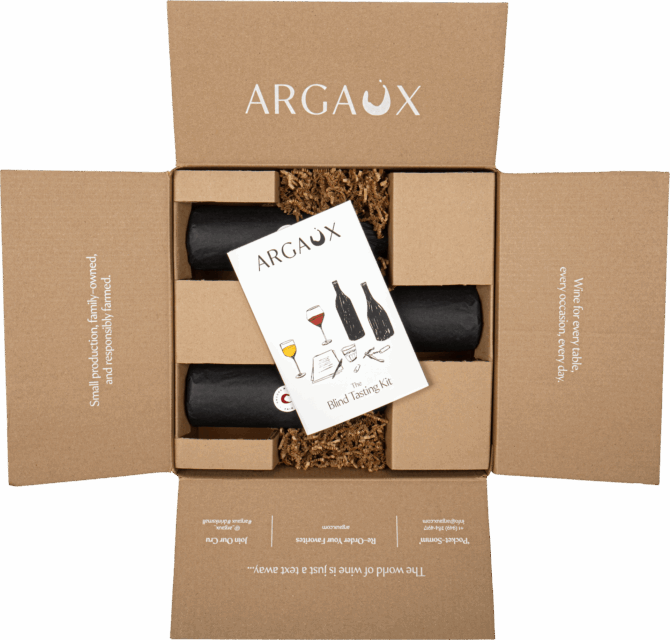
If you'd rather skip the wrapping and numbering, the Argaux Blind Wine Tasting Kit does it for you. It comes with sommelier-selected wines wrapped in tissue paper with numbered seals, the Argaux Tasting Guide, and The Infamous Tasting Grid, which takes you through sight, nose and palate before you commit to a call. When you're ready for the reveal, text a photo of the label to your Pocket Somm.
Kits come in two, three or four bottles, at $100, $125 and $150. The wines can change through the year. Ordering for a team? Several kits can ship to several addresses, and the shipping policy has the details.
| Option | What you get | Cost |
|---|---|---|
| Argaux Blind Wine Tasting Kit | Wrapped, numbered wines, the tasting guide and the grid. You run it yourself. | $100 (two bottles), $125 (three), $150 (four) |
| Host your own | You choose, cover and number the wines. | Depends on the bottles you buy |
| Corporate virtual tasting | A live, sommelier-led Zoom session of about an hour for a group. | Hosted experiences begin at a $1,250 flat sommelier fee; wine and shipping are extra |
See the Blind Wine Tasting Kits
Want more bottles to practice on? Club Argaux is a wine membership built around discovery and education.
FAQ
What is a blind wine tasting?
A blind wine tasting is a tasting where you don't know which wine is in your glass. The bottles are covered, so you judge by sight, smell and taste, then guess the grape, region, vintage and price. Afterward you reveal the labels and compare. It works for one person, a couple or a group.
What does a blind tasting hide, and what doesn't it hide?
A blind tasting hides the label, the producer, the region and the price. It does not hide color. Color shows in the glass, and in an Argaux kit the numbered seal also tells you the style. Color matters: in a 2001 Bordeaux study, 54 wine-science students described a white wine dyed red with red-wine words.
Does blind tasting really work?
It keeps label and price out of your opinion, but it isn't precise. Only about 10 percent of competition judges kept every repeat score within one medal group (Hodgson, 2008). Untrained tasters didn't favor pricier wines (Goldstein, 2008). Our kit page says: "The goal isn't to get it right. It's to pay attention — and fine-tune what you know you love."
Can you guess a wine's price blind?
The research doesn't test that directly. Robin Goldstein's 2008 study of 17 blind tastings asked how much people liked each wine, not what it cost. Across 6,175 ratings of wines costing $1.65 to $150, tasters without wine training rated pricier wines slightly lower on average. Price is a weak signal in the glass, so hold your price call loosely.
How many wines are in a blind tasting?
It depends who sets it up. If you build a tasting yourself, our hosting guide suggests four to six bottles: fewer than four gives little contrast, and more than six tires your palate. Argaux kits come with two, three or four bottles, at $100, $125 and $150.
What do you need for a blind wine tasting?
Covered bottles, a number on each one, a clean glass per wine for each person, water, a pen and paper, and a friend who keeps the answer key. A spit bucket is optional. Our guide to hosting a blind wine tasting at home has the full shopping list.
Does Argaux sell a blind tasting kit?
Yes. The Argaux Blind Wine Tasting Kit comes in two, three or four bottles, at $100, $125 and $150. Each includes sommelier-selected wines wrapped in tissue paper with numbered seals, the Argaux Tasting Guide and tasting grids. The kit page shows the current options.
Sources
- Morrot, G., Brochet, F., & Dubourdieu, D. (2001). The color of odors. Brain and Language, 79(2), 309–320. doi:10.1006/brln.2001.2493
- Goldstein, R., Almenberg, J., Dreber, A., Emerson, J. W., Herschkowitsch, A., & Katz, J. (2008). Do more expensive wines taste better? Evidence from a large sample of blind tastings. Journal of Wine Economics, 3(1), 1–9. doi:10.1017/S1931436100000523
- Hodgson, R. T. (2008). An examination of judge reliability at a major U.S. wine competition. Journal of Wine Economics, 3(2), 105–113. doi:10.1017/S1931436100001152